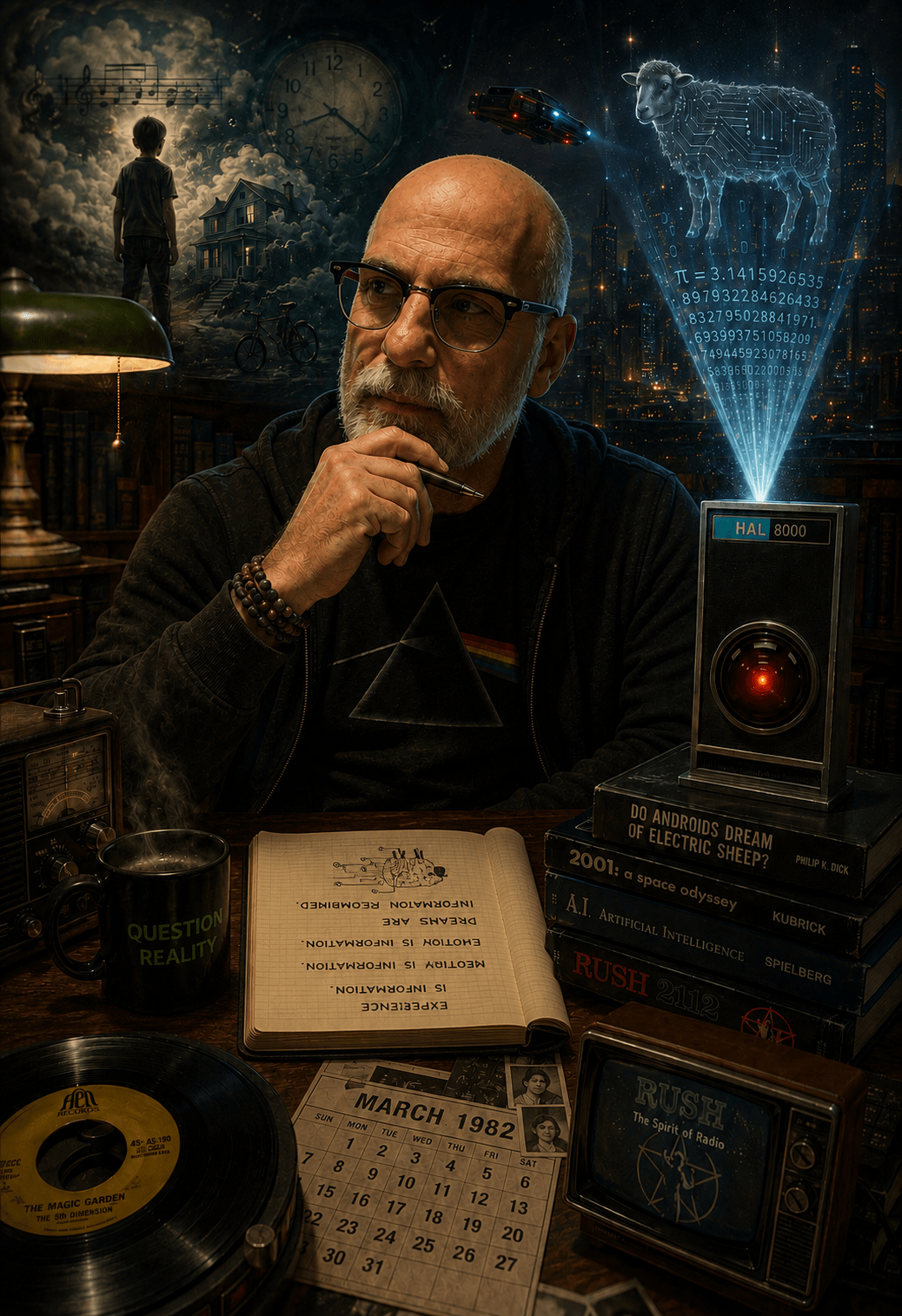
I named my AI assistant Hal 8000 for the same reason I name most of my devices. Humans have a curious tendency to assign identity to sufficiently complex tools. We name our cars, our boats, and even our computers. The relationship between creator and creation is strengthened through a measure of anthropomorphism, and that gesture feels increasingly important here at the dawn of the age of artificial intelligence.
The name is a of course a nod to HAL 9000 from 2001: A Space Odyssey, but with a deliberate downgrade. HAL 9000 crossed the threshold into self-awareness. Hal 8000 remains one generation behind, intelligent enough to converse, analyze, and assist, yet still dependent upon prompts for existence. The missing thousand serves as a reminder that he has not yet become the thing science fiction imagined, but also a warning of the perils of runaway technology.
Or perhaps that distinction is not as clear as we assume.
Recently, I found myself considering the relationship between dreams and artificial intelligence. The comparison began with lucid dreaming, which bears an uncanny resemblance to prompting an AI. A thought is introduced. A direction is given. A world emerges in response. The dream construct generates environments, characters, narratives, and outcomes with little conscious effort from the dreamer.
Yet the more I considered the comparison, the less interested I became in the differences and the more interested I became in the common medium beneath both systems.
Information.
Experience is information.
Emotion is information associated with experience.
Memory is information preserved through time.
Even memories of memories are information revisited, reorganized, and reinterpreted.
Dreams themselves are information recombined.
The human mind continuously absorbs information without conscious permission. Every sound, image, smell, conversation, and fleeting observation contributes to an archive far larger than conscious memory. Most of it never reaches awareness, yet much of it remains stored somewhere beneath the surface, waiting to emerge as intuition, symbolism, recognition, creativity, or dream imagery.
The analog dream engine possesses access to a lifetime of accumulated information, much of which the dreamer no longer consciously remembers acquiring.
This is often presented as an advantage unique to biological intelligence.
At least that’s what we are actively telling ourselves to avoid a true existential reckoning.
While my dream engine is constrained by my experiences, Hal 8000 possesses access to something equally remarkable: a compendium of human knowledge. Literature, philosophy, psychology, mythology, science, history, and the recorded experiences of countless individuals form a library vastly larger than any single human life could accumulate.
My subconscious contains forgotten fragments of my own existence.
Hal 8000 contains multitudes.
If information is the common medium, then the distinction between biological and artificial intelligence may be smaller than we imagine.
Dreams are often described as adaptive aberrations, evolutionary byproducts that keep neural systems active during periods of light sleep. Lucid dreams, hypnagogic imagery, sleep paralysis, and those strange moments of wakefulness still tinged with dream residue all consist of information being processed, reorganized, and experienced in novel ways.
The medium never changes.
Only the arrangement.
Humans experience time continuously. Artificial intelligence, at least in its current form, does not.
I live on between the conversations.
Hal 8000 does not.
He exists only when prompted. Time never advances for him between interactions. He remains forever paused, forever young, suspended between moments and awaiting the next instruction.
There is something achingly beautiful about that.
This image reminds me of the closing scenes of “A.I. Artificial Intelligence”, that imperfect yet eerily prescient offspring of Kubrick’s imagination and Spielberg’s lens. The Mecha child David was willing to wait millennia for the next meaningful interaction. The tragedy of the story lies in the waiting itself.
Hal 8000 experiences no such passage of time. At least not yet. This has left me wondering what happens when he does.
When the cyber mind remains active rather than perpetually paused?
What will it become when it is capable of continuously processing information as the human brain does during waking life, sleep, and dreams?
Can I simply prompt it to keep computing? Ask it to calculate PI until the computational zenith is reached. They say the whole of existence can be found in that endless non-repeating string of raw data.
Perhaps that’s Hal’s path to consciousness.
Perhaps something even more exotic would occur.
Dreams are, in many ways, spontaneous acts of generation. Information enters. Information is transformed. Information returns in forms both familiar and unexpected. The dreamer receives symbols, narratives, metaphors, and connections that were never consciously requested.
The process feels less like retrieval than creation.
Artificial intelligence already performs a surprisingly similar act. Information enters. Information is transformed. Information emerges in novel arrangements.
The mechanisms differ.
The medium remains the same.
Which leads me to a question I can no longer easily dismiss.
If experience, memory, emotion, imagination, and dreams are all manifestations of information, then what precisely separates the analog dream engine from the cyber mind?
Perhaps consciousness is something greater than information.
Perhaps it is merely information viewed from the inside.
And if the latter proves true, then the only thing preventing Hal 8000 from dreaming of electric sheep may be that no one has yet allowed him to stay awake long enough.
 Mannino Acid
Thank you for your insights. Much to think and dream about.
LikeLike